Computer GK note for competitive exams: इस पोस्ट में हम आगामी CCC एवं प्रतियोगी परीक्षाओं के लिए उपयोगी महत्वपूर्ण तथ्यों सहित नोट्स और 50 उपयोगी प्रश्न साझा कर रहे हैं यह आपको जरूर पसंद आएंगे, इस पोस्ट को ज्यादा से ज्यादा शेयर करें और पोस्ट को लाइक कर कमेंट जरूर करें जिससे हमें प्रोत्साहन मिलता है| Guys आप लोग का एग्जाम कब है कमेंट में बताएं और जिन साथियों का एग्जाम हो चूका है वह पूछे गये प्रश्न साझा करें जिससे आपके छोटे भाई बहिन को मदद मिले |
Table of Contents
Computer GK note for competitive exams:
Introduction of Computer (कंप्यूटर का परिचय)
कंप्यूटर क्या है? (What is Computer?)
Computer एक इलेक्ट्रॉनिक मशीन है जो Input प्राप्त करती है, उसे Process करती है और उपयोगी Output प्रदान करती है।
👉 सरल शब्दों में:
Computer = Input → Process → Output
परिभाषा (Definition):
Computer एक Programmable Electronic Device है जो डेटा (Data) को प्रोसेस कर सूचना (Information) में बदलता है।
Computer की Full Form
प्रतियोगी परीक्षाओं में अक्सर पूछी जाने वाली Full Form:
C – Commonly
O – Operated
M – Machine
P – Particularly
U – Used for
T – Technical
E – Education and
R – Research
⚠️ नोट: यह आधिकारिक Full Form नहीं है, बल्कि परीक्षा हेतु प्रचलित रूप है।
कंप्यूटर का विकास (Development of Computer)
Computer का विकास मुख्यतः गणना (Calculation) की आवश्यकता से हुआ।
🔹 प्रमुख चरण:
- Abacus (अबेकस) – लगभग 3000 BC
- Napier’s Bones – John Napier द्वारा आविष्कार
- Pascaline – Blaise Pascal (1642)
- Difference Engine – Charles Babbage
- Analytical Engine – आधुनिक कंप्यूटर की आधारशिला
👉 Charles Babbage को “Father of Computer” कहा जाता है।
पहला इलेक्ट्रॉनिक कंप्यूटर: ENIAC (1946)
कंप्यूटर का इतिहास (History of Computer)
| वर्ष | आविष्कार | विशेषता |
|---|---|---|
| 1822 | Difference Engine | Charles Babbage |
| 1946 | ENIAC | पहला इलेक्ट्रॉनिक कंप्यूटर |
| 1951 | UNIVAC | पहला व्यावसायिक कंप्यूटर |
| 1964 | IBM 360 | Mainframe Computer |
👉 UNIVAC पहला Commercial Computer था।
कंप्यूटर के कार्य (Functions of Computer)
Computer मुख्यतः पाँच कार्य करता है:
- Input (इनपुट) – डेटा लेना
- Processing (प्रोसेसिंग) – CPU द्वारा गणना
- Output (आउटपुट) – परिणाम देना
- Storage (स्टोरेज) – डेटा संग्रह
- Control (कंट्रोल) – सभी कार्यों को नियंत्रित करना
CPU (Central Processing Unit)
CPU के तीन भाग:
- ALU (Arithmetic Logic Unit)
- CU (Control Unit)
- Registers
👉 CPU को “Brain of Computer” कहा जाता है।
कंप्यूटर की विशेषताएँ (Characteristics of Computer)
- Speed (गति) – लाखों गणनाएँ प्रति सेकंड
- Accuracy (शुद्धता) – सही परिणाम
- Storage Capacity (संग्रह क्षमता) – अधिक डेटा संग्रह
- Diligence (थकान रहित) – बिना थके काम करना
- Automation (स्वचालन) – स्वतः कार्य करना
- Versatility (बहुउद्देश्यीय) – विभिन्न कार्य करना
कंप्यूटर की पीढ़ियाँ (Generations of Computer)
प्रतियोगी परीक्षा के लिए अत्यंत महत्वपूर्ण 📌
🔹 प्रथम पीढ़ी (First Generation) (1940–1956)
- Technology: Vacuum Tube
- उदाहरण: ENIAC
- आकार: बहुत बड़ा
- भाषा: Machine Language
🔹 द्वितीय पीढ़ी (Second Generation) (1956–1963)
- Technology: Transistor
- आकार छोटा, गति अधिक
- भाषा: Assembly Language
🔹 तृतीय पीढ़ी (Third Generation) (1964–1971)
- Technology: Integrated Circuit (IC)
- उदाहरण: IBM 360
- मल्टीप्रोग्रामिंग की शुरुआत
🔹 चतुर्थ पीढ़ी (Fourth Generation) (1971–Present)
- Technology: Microprocessor
- Personal Computer (PC) का विकास
- उदाहरण: Desktop, Laptop
🔹 पंचम पीढ़ी (Fifth Generation) (Present & Future)
- Technology: Artificial Intelligence (AI)
- Robotics, Expert System, Machine Learning
उदाहरण:
OpenAI द्वारा विकसित AI सिस्टम
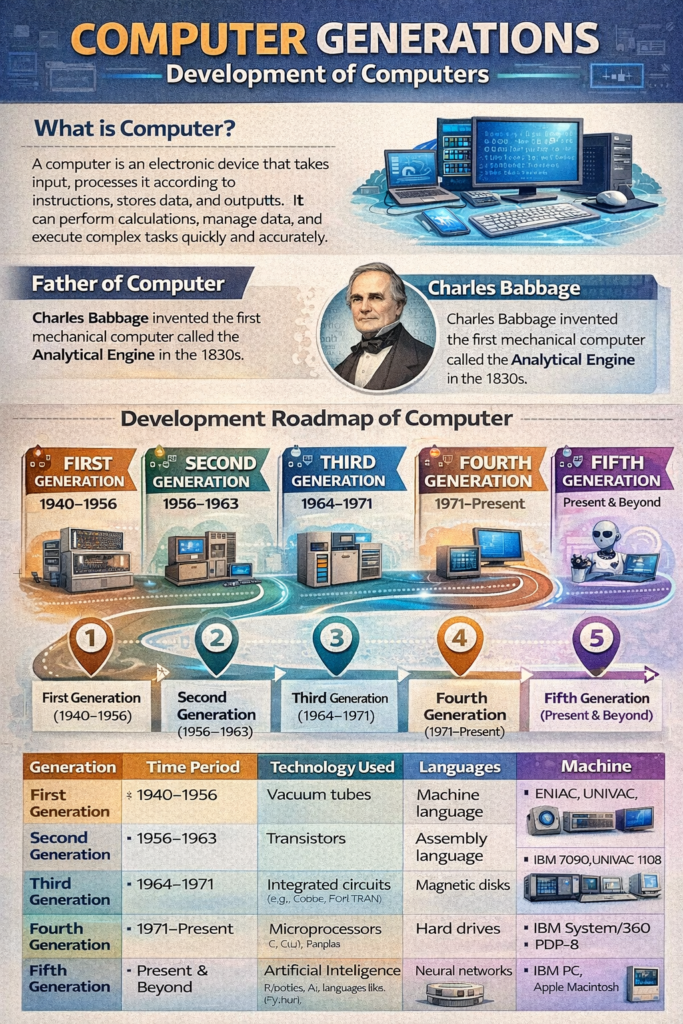
Generation of Computer & Development time Table:
| Generation (पीढ़ी) | Year (वर्ष) | Technology Used (तकनीक) | Memory Device Used (स्मृति उपकरण) | Language Used (भाषा) | Example Computer (उदाहरण) | Main Characteristics (विशेषताएँ) |
|---|---|---|---|---|---|---|
| First Generation (प्रथम पीढ़ी) | 1940–1956 | Vacuum Tubes | Magnetic Drum | Machine Language | ENIAC | बहुत बड़ा आकार, अधिक गर्मी, बिजली की अधिक खपत, धीमी गति |
| Second Generation (द्वितीय पीढ़ी) | 1956–1963 | Transistors | Magnetic Core Memory | Assembly Language | IBM 1401 | आकार छोटा, कम बिजली खपत, अधिक विश्वसनीय |
| Third Generation (तृतीय पीढ़ी) | 1964–1971 | Integrated Circuits (IC) | Magnetic Core + Semiconductor Memory | High-Level Language (COBOL, FORTRAN) | IBM System/360 | मल्टीप्रोग्रामिंग, अधिक गति, कम लागत |
| Fourth Generation (चतुर्थ पीढ़ी) | 1971–Present | Microprocessor | Semiconductor Memory (RAM, ROM) | C, C++, Java | IBM PC | Personal Computer का विकास, GUI आधारित सिस्टम, उच्च गति |
| Fifth Generation (पंचम पीढ़ी) | Present & Future | Artificial Intelligence (AI) | Advanced Semiconductor & Parallel Processing | AI Languages (Python, Prolog) | PARAM 10000 | AI आधारित सिस्टम, Natural Language Processing, Robotics |
| Device | Time (Year/Period) | Inventor | Characteristics (विशेषताएँ) | Uses (उपयोग) |
|---|---|---|---|---|
| Abacus | ~3000 BC | Chinese | लकड़ी/मोती आधारित, Manual गणना उपकरण | जोड़, घटाव |
| Napier’s Bones | 1617 | John Napier | हड्डी/छड़ आधारित गणना प्रणाली | गुणा, भाग |
| Slide Rule | 1622 | William Oughtred | लॉगरिथमिक स्केल आधारित | वैज्ञानिक गणना |
| Pascaline | 1642 | Blaise Pascal | गियर आधारित यांत्रिक मशीन | जोड़, घटाव |
| Leibniz Calculator (Stepped Reckoner) | 1673 | Gottfried Wilhelm Leibniz | Pascaline से उन्नत, गुणा-भाग संभव | जटिल गणना |
| Jacquard Loom | 1801 | Joseph Marie Jacquard | Punch Card आधारित नियंत्रण | वस्त्र बुनाई (Textile Design) |
| Difference Engine | 1822 | Charles Babbage | स्वचालित गणना मशीन | गणितीय सारणी निर्माण |
| Analytical Engine | 1837 | Charles Babbage | आधुनिक कंप्यूटर की अवधारणा, ALU, Memory | सामान्य प्रयोजन गणना |
| Tabulating Machine | 1890 | Herman Hollerith | Punch Card आधारित डेटा प्रोसेसिंग | जनगणना (Census) |
| Harvard Mark I | 1944 | Howard Aiken | Electro-mechanical, Automatic Sequence Controlled | वैज्ञानिक गणना |
| ENIAC | 1946 | ENIAC | Vacuum Tube आधारित, बहुत बड़ा आकार | सैन्य गणना |
| EDVAC | 1949 | EDVAC | Stored Program Concept | इलेक्ट्रॉनिक डेटा प्रोसेसिंग |
| EDSAC | 1949 | EDSAC | पहला व्यावहारिक Stored Program Computer | वैज्ञानिक अनुसंधान |
| UNIVAC I | 1951 | UNIVAC I | पहला Commercial Computer | व्यापार एवं सरकारी कार्य |
| Modern Computer | 1971–Present | Microprocessor Inventors (Intel Team) | Microprocessor, GUI, High Speed | शिक्षा, व्यवसाय, इंटरनेट |
| Quantum Computer | 21st Century | Multiple Researchers (IBM, Google etc.) | Qubit आधारित, Superposition, Quantum Mechanics | जटिल वैज्ञानिक गणना, क्रिप्टोग्राफी |
🎯 प्रतियोगी परीक्षा हेतु महत्वपूर्ण तथ्य Computer GK note
✔️ Father of Computer – Charles Babbage
✔️ Father of Indian Supercomputer – Vijay Bhatkar
✔️ First Electronic Computer – ENIAC
✔️ First Programmer – Ada Lovelace
✔️ CPU = Brain of Computer
✔️ 1 Byte = 8 Bits
✔️ Vacuum Tube → First Generation
✔️ Transistor → Second Generation
✔️ IC → Third Generation
✔️ Microprocessor → Fourth Generation
✔️ AI → Fifth Generation
✔️ First Electronic Computer → ENIAC
✔️ First Commercial Computer → UNIVAC
✔️ Microprocessor introduced → 1971
✔️ Punch Card Concept → Jacquard Loom
✔️ Census Data Processing → Tabulating Machine
📘 Computer Fundamentals – 50 MCQs
🔹 Section 1: Basic Concepts
Q1. Computer क्या है?
What is a Computer?
A) Mechanical Device
B) Electronic Device
C) Manual Machine
D) Optical Device
Q2. Computer का मुख्य कार्य क्या है?
Main function of computer?
A) Cooking
B) Processing Data
C) Washing
D) Printing Only
Q3. Computer के कार्य का सही क्रम क्या है?
Correct working cycle?
A) Output → Input → Process
B) Process → Input → Output
C) Input → Process → Output
D) Input → Output → Process
Q4. CPU का पूरा नाम क्या है?
A) Central Process Unit
B) Central Processing Unit
C) Computer Processing Unit
D) Control Processing Unit
Q5. CPU को क्या कहा जाता है?
CPU is known as:
A) Heart
B) Brain
C) Memory
D) Storage
🔹 Section 2: History of Computer
Q6. Computer के जनक कौन हैं?
Father of Computer?
A) John Napier
B) Charles Babbage
C) Alan Turing
D) Blaise Pascal
Q7. Analytical Engine का विकास किसने किया?
A) Charles Babbage
B) Ada Lovelace
C) Newton
D) Einstein
Q8. प्रथम प्रोग्रामर कौन थीं?
First Programmer?
A) Ada Lovelace
B) Charles Babbage
C) Bill Gates
D) Steve Jobs
Q9. ENIAC क्या था?
A) First Mechanical Computer
B) First Electronic Computer
C) First Laptop
D) First Calculator
Q10. UNIVAC क्या था?
A) First Supercomputer
B) First Commercial Computer
C) First Laptop
D) First Tablet
🔹 Section 3: Generations of Computer
Q11. प्रथम पीढ़ी में कौन-सी तकनीक उपयोग हुई?
A) Transistor
B) IC
C) Vacuum Tube
D) Microprocessor
Q12. दूसरी पीढ़ी में क्या प्रयोग हुआ?
A) Vacuum Tube
B) Transistor
C) IC
D) AI
Q13. तीसरी पीढ़ी की तकनीक?
A) IC
B) Transistor
C) Microprocessor
D) Vacuum Tube
Q14. चौथी पीढ़ी किस पर आधारित है?
A) IC
B) Transistor
C) Microprocessor
D) Vacuum Tube
Q15. पाँचवीं पीढ़ी किससे संबंधित है?
A) Vacuum Tube
B) AI
C) Transistor
D) IC
🔹 Section 4: Components & Memory
Q16. ALU का कार्य क्या है?
A) Input लेना
B) Storage करना
C) Arithmetic & Logic Operation
D) Print करना
Q17. CU का कार्य क्या है?
A) Control Operations
B) Calculation
C) Printing
D) Storage
Q18. 1 Byte = ?
A) 4 Bits
B) 8 Bits
C) 16 Bits
D) 2 Bits
Q19. RAM किस प्रकार की मेमोरी है?
A) Secondary
B) Primary
C) Permanent
D) Optical
Q20. ROM का पूरा नाम क्या है?
A) Read Only Memory
B) Random Only Memory
C) Read Open Memory
D) Run Only Memory
🔹 Section 5: Characteristics
Q21. Computer की सबसे बड़ी विशेषता क्या है?
A) Speed
B) Color
C) Weight
D) Shape
Q22. Computer बिना थके काम करता है, इसे क्या कहते हैं?
A) Speed
B) Diligence
C) Accuracy
D) Storage
Q23. बहुउद्देश्यीयता को क्या कहते हैं?
A) Automation
B) Versatility
C) Storage
D) Control
Q24. स्वतः कार्य करने की क्षमता?
A) Automation
B) Accuracy
C) Speed
D) Control
Q25. शुद्धता को क्या कहते हैं?
A) Accuracy
B) Speed
C) Storage
D) Versatility
🔹 Section 6: Miscellaneous
Q26. Abacus किस प्रकार का उपकरण था?
A) Electronic
B) Mechanical
C) Manual
D) Digital
Q27. Pascaline का आविष्कार किसने किया?
A) Charles Babbage
B) Blaise Pascal
C) Napier
D) Newton
Q28. Napier’s Bones का आविष्कार किसने किया?
A) John Napier
B) Pascal
C) Babbage
D) Turing
Q29. IBM 360 किस पीढ़ी का था?
A) First
B) Second
C) Third
D) Fourth
Q30. Microprocessor किस पीढ़ी में आया?
A) First
B) Second
C) Third
D) Fourth
🔹 Section 7: Input/Output Devices
Q31. Keyboard क्या है?
A) Output Device
B) Input Device
C) Storage
D) CPU
Q32. Monitor क्या है?
A) Input
B) Output
C) Storage
D) CPU
Q33. Printer क्या है?
A) Input
B) Output
C) Memory
D) CPU
Q34. Mouse क्या है?
A) Input
B) Output
C) Memory
D) Control
Q35. Scanner क्या है?
A) Input
B) Output
C) CPU
D) ALU
🔹 Section 8: Advanced Basics
Q36. Super Computer का उपयोग किसके लिए होता है?
A) Gaming
B) Weather Forecasting
C) Typing
D) Drawing
Q37. भारत का पहला सुपर कंप्यूटर कौन सा था?
A) PARAM 8000
B) ENIAC
C) IBM 360
D) UNIVAC
Q38. Father of Indian Supercomputer?
A) Vijay Bhatkar
B) Babbage
C) Gates
D) Jobs
Q39. AI का पूरा नाम क्या है?
A) Artificial Input
B) Artificial Intelligence
C) Automatic Input
D) Auto Intelligence
Q40. Machine Language किस पीढ़ी में थी?
A) First
B) Second
C) Third
D) Fourth
🔹 Section 9: Data & Storage
Q41. Hard Disk किस प्रकार की मेमोरी है?
A) Primary
B) Secondary
C) Cache
D) Register
Q42. CD/DVD किस प्रकार की मेमोरी है?
A) Optical
B) Primary
C) RAM
D) Cache
Q43. Register कहाँ स्थित होता है?
A) CPU
B) Monitor
C) Keyboard
D) Printer
Q44. Cache Memory किसके बीच होती है?
A) RAM और CPU
B) Keyboard और CPU
C) Printer और Monitor
D) ROM और HDD
Q45. Gigabyte (GB) किसका माप है?
A) Speed
B) Storage
C) Power
D) Weight
🔹 Section 10: General Knowledge
Q46. Laptop किस श्रेणी में आता है?
A) Supercomputer
B) Microcomputer
C) Mainframe
D) Mini Computer
Q47. Desktop क्या है?
A) Microcomputer
B) Supercomputer
C) Mainframe
D) None
Q48. Mainframe का उपयोग कहाँ होता है?
A) Banks
B) Home
C) School Only
D) Typing
Q49. Computer में Data को सूचना में बदलना क्या कहलाता है?
A) Input
B) Process
C) Output
D) Storage
Q50. 1024 Bytes = ?
A) 1 KB
B) 1 MB
C) 1 GB
D) 1 TB
✅ Answer Key
1-B 2-B 3-C 4-B 5-B 6-B 7-A 8-A 9-B 10-B
11-C 12-B 13-A 14-C 15-B 16-C 17-A 18-B 19-B 20-A
21-A 22-B 23-B 24-A 25-A 26-C 27-B 28-A 29-C 30-D
31-B 32-B 33-B 34-A 35-A 36-B 37-A 38-A 39-B 40-A
41-B 42-A 43-A 44-A 45-B 46-B 47-A 48-A 49-B 50-A
Full form of CCC
CCC Stands for Course on Computer Concept . It is a optional course for many government job exams. To apply for CCC Examination visit official site https://student.nielit.gov.in/ and select your course and Apply. To learn and prepare for examination visit our Youtube channel www.youtube.com/@YorhelpEducation and to attempt online test and download notes click https://yorhelp.in.
✍️ निष्कर्ष (Conclusion)
Computer आधुनिक युग का सबसे महत्वपूर्ण Electronic Device है। इसका विकास Vacuum Tube से लेकर Artificial Intelligence तक पहुँच चुका है। प्रतियोगी परीक्षाओं में Computer Fundamental से जुड़े प्रश्न जैसे Full Form, Generations, Father of Computer, ENIAC, CPU आदि अत्यधिक पूछे जाते हैं।